 Gautham Prasad
I'll never forget the takt planning activity I took part in several years ago. We created an assembly line and built airplanes out of Legos. The person leading the activity told us to stop and announced that there was a quality issue in one of the steps — all of the units had to be discarded. We went through several iterations of how to best organize our assembly line to be efficient. In each iteration, we encountered a quality issue in one of the steps. As the activity evolved into the final expression of takt planning, what we noticed was that these quality issues had less and less of an impact on meeting our schedule.
This speaks to the brilliance of takt planning, but at LCI we know it's not enough to simply meet our schedule. We're here to deliver best value. What if those quality issues were never discovered? What if they're not discovered early enough and the impact of fixing the issue is cost and time prohibitive? Finding quality issues early is crucial in reducing defects — one of the 8 Wastes of Lean.
The Challenge of MEP Verification
Periodic inspections become a reliable way to ensure what is being installed. How do you inspect your MEP system? How do you verify that your VAV has the required clearance in front of it? How do you make sure the duct is installed in the right spot, so it does not conflict with systems being added later in the flow? Walking around with installation drawings and pulling tape is not practical. We need to leverage technology to verify MEP systems are installed per BIM coordination.
Augmented Reality in the Field
In my 2024 LCI Congress live lab entitled Follow Through: MEP Verification that's Actually Efficient, I demonstrated how augmented reality can help. The same model used in MEP coordination can be brought into the field on a tablet. I showcased only one platform, but there are several platforms that can load the model onto your tablet, scale it to real life, and position the model correctly.
Once the model is positioned, the transparency of the model can be adjusted. You can slide between only seeing the real condition, only seeing the model, or seeing a shaded model on top of the existing condition. This lets you easily compare the model to the installed condition and determine if there is an issue. Once a conflict has been identified, an issue can be created in your project management platform to track progress.
What Does This Really Bring Us?
Augmented Reality MEP verification provides a way to check the quality of MEP installation at any point. It is efficient and straightforward. On many occasions I have seen a contractor make a mistake that other contractors end up fixing. Being able to identify the offending contractor ensures accountability and sets an expectation of how work is to be completed.
As a BIM professional, the greatest value of Augmented Reality MEP verification is that you don't need your BIM guy to do it. Managers, superintendents, and project engineers can all grab their tablets and get to work. This puts BIM tools in the hands of the people whose boots are on the ground. The model becomes alive and useful throughout the project. Additionally, project teams become more aware of the power BIM tools have to offer.
All of my best solutions come from my project teams. Someone out in the field calls me up and says something like, "I don't know if this is possible, but can you do this for me?" Keeping VDC front of mind is what gets project teams to leverage us for out-of-the-box solutions.
Lastly, reducing rework improves safety. Every time someone has to get up on a ladder to install a VAV, they are taking a risk. If they then have to get back on that ladder to remove the VAV, then get on the ladder again to install it in a different location, they have effectively tripled their exposure to risk. BIM coordination and Augmented Reality MEP verification go hand in hand to reduce the inherent risk workers are exposed to.
How to Get Started
In order to implement Augmented Reality MEP verification, get your VDC team member involved early. You will need to go through an extensive coordination process with your subcontractors. The coordinated model will be used in the Augmented Reality platform.
Popular platforms include:
- Trimble Sitevision
- Revizto
- Gamma AR
- Sitelink
Some platforms require that you place QR codes in key locations onsite. The codes are scanned to scale and position the model. Some platforms rely heavily on a LiDAR-equipped tablet and are able to position the model by reconciling model geometry with onsite walls, structure, and slabs.
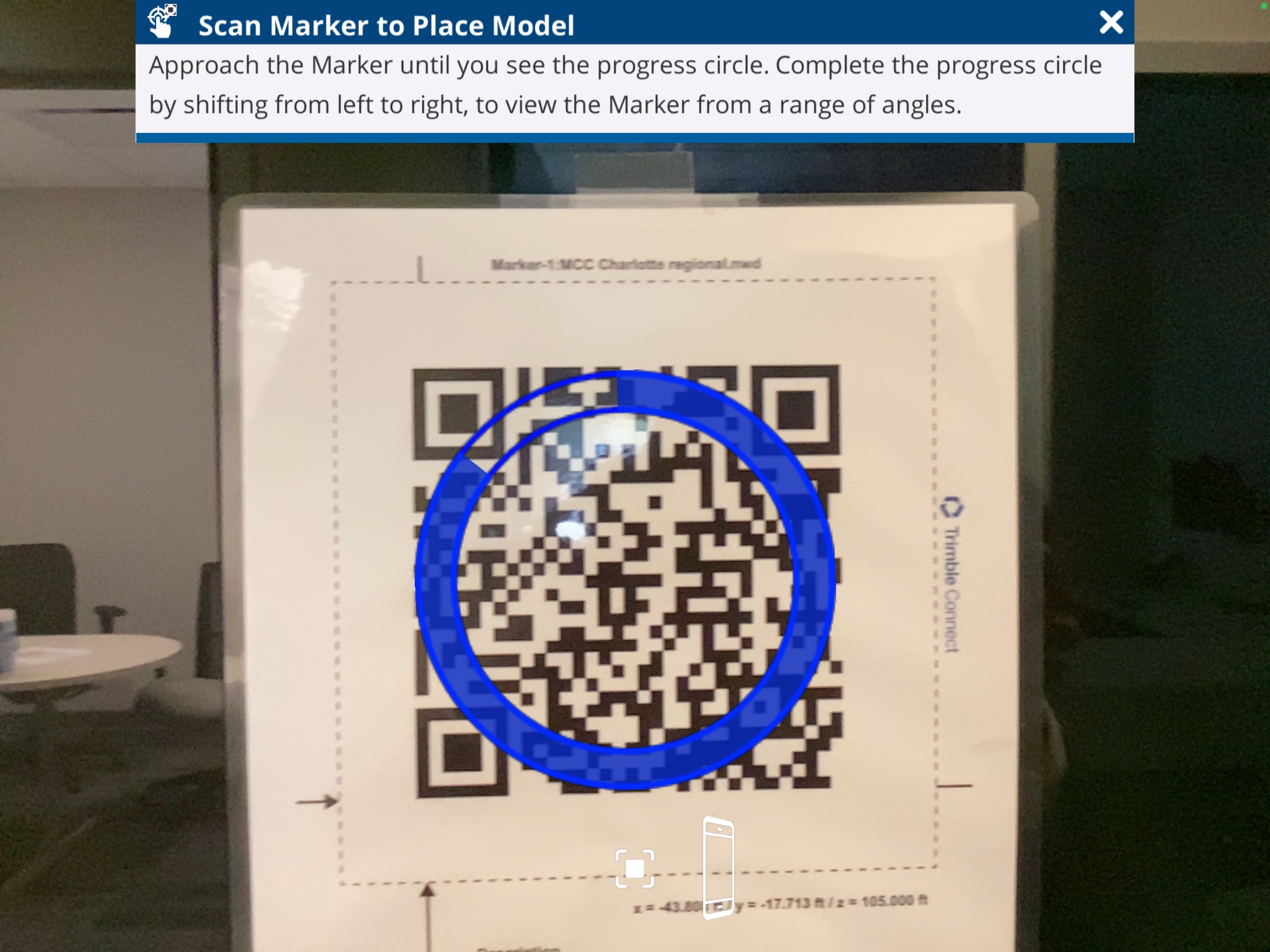
QR codes placed onsite are scanned to scale and position the AR model accurately in the field.