 Dr. Gongfan Chen

Back in the 1990s, Lauri Koskela1 highlighted seven key constraints that must be removed during planning from a production perspective: 1) design and working methods, 2) materials, 3) labor, 4) equipment and tools, 5) space, 6) prerequisite work, and 7) external conditions. When the project enters a new production phase, teams must constantly ask whether these seven types of constraints have been reliably removed.
Removing these constraints isn't easy. In current construction practice, it relies heavily on centralized managers to traverse between sites and trailers, check contractual responsibilities, identify constraints, and coordinate with teams to remove them. This places heavy burdens and significant cognitive demands on these managers, who are responsible for ensuring all resources are "make-ready" before releasing them to downstream production. In today's fast-changing construction environments, the ability to identify and remove constraints in a timely manner isn't just helpful — it's essential for keeping projects on track and maintaining a reliable and continuous workflow.
What Are Smart Contracts?
In recent years, smart contracts have become a hot topic in construction, introducing the concept of decentralization that can facilitate centralized jobs. Construction projects essentially run on contracts — the rules and agreements that form the backbone of every project, ensuring clarity, accountability, and trust among all parties involved. A smart contract, however, takes this concept further. Instead of being just a written agreement, it is a piece of code that defines responsibilities and risks among the parties involved.
Operating on simple "if-then" logic, a smart contract automatically executes predefined actions once specific conditions are met, and all transactions are recorded on the blockchain transparently, where all parties can easily access and audit. A common way to think about smart contracts is to picture a vending machine: you insert a couple of dollars, and without any middleman, the machine delivers exactly what you agreed to receive.
From Centralized Push to Decentralized Pull
Smart contracts have the potential to redefine traditional construction management. Instead of relying on centralized coordination, construction project execution could be governed by well-crafted smart contract rules that drive self-coordination. For example, once smart contract clauses are in place, centralized project managers can step back from time-consuming tasks such as monitoring, record-keeping, and payment approvals. A smart contract–powered automated system can continuously track project progress and maintain a steady workflow.
This decentralized system might also rely on reality-capture technologies and AI-driven compliance checks to ensure that tasks are truly "production-ready" before they move downstream. In lean construction, Howell2 emphasized the importance of shifting construction management from a centralized push to a decentralized pull to achieve bottom-up coordination. Smart contracts introduce a form of decentralization that fits naturally within lean theory.
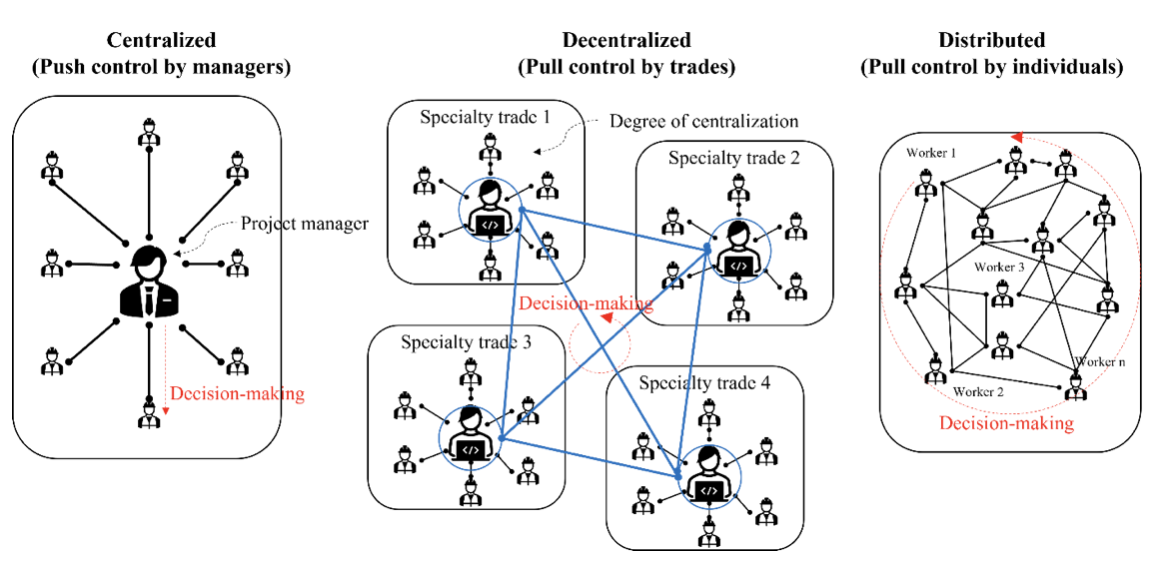
Figure 1. Centralized "push" vs. decentralized "pull"
The Challenge: Implicit Constraints
However, smart contracts may struggle to handle constraints effectively because construction projects are inherently dynamic, complex, and ever-changing. Many on-site constraints are vague, difficult to quantify, and often implicit, while smart contracts demand precise, deterministic inputs and outputs — an inherent contradiction within real-world contexts. Translating these evolving constraints into clear, enforceable smart contract terms remains a significant challenge.
Researchers have pointed out that construction resources (e.g., workers, equipment, materials) can be turned into consensus terms to enable direct communications between the construction process and smart contract networks.3 This perspective implies that these supporting resource flows could be used as a constraint removal "Check" mechanism for smart contracts to consider.
An Adaptive Smart Contract System
With this vision, our research designs an adaptive smart contract system that can turn complex construction constraints into actionable management rules. We focused on four key types of constraints: external conditions, material availability, equipment availability, and labor availability — each with a different variability level based on collected empirical data.
Our approach deploys a simulation model to elaborate on combinations and permutations of these constraints and maps out all possible scenarios that could slow or interrupt the project workflow. To drive automatic constraint removal through bottom-up coordination, we applied game theory (Shapley value) to assign rewards or penalties depending on whether a party can reliably remove a specific constraint (e.g., the supplier ensures materials arrive just in time). These bundled constraint scenarios form the "if," and the corresponding incentives form the "then," allowing our smart contracts to dynamically self-coordinate different parties to enable a continuous workflow.
The results showed that worker availability becomes the bottleneck constraint in the system because it limits the capacity of the entire production process — and should therefore be prioritized in smart contract design.
Lean Make-Ready Meets Smart Contracts
Integrating lean constraint-removal principles into smart contracts enhances their situational awareness in dynamic construction environments. Decentralized management requires smart contracts to be "intelligent" enough to perform functions traditionally handled by centralized project managers. A well-designed smart contract can anticipate and address governing constraints before tasks are released into production.
In this way, the smart contract focuses on the "make-ready" process, proactively preventing situations where crews wait for conditions to mature — rather than relying on reactive interventions from centralized control.
1 Koskela, L., 1999, Management of production in construction: a theoretical view, 7th Annual Conference of the International Group for Lean Construction (IGLC 7), 241–252.
2 Howell, G., 1999, What is lean construction, 7th Annual Conference of the International Group for Lean Construction, vol. 7, 1–10, Berkeley, California, USA.
3 Lu, W., Li, X., Xue, F., Zhao, R., Wu, L. & Yeh, A.G.O., 2021, 'Exploring smart construction objects as blockchain oracles in construction supply chain management', Automation in Construction, 129, 103816.