 Alaa Al Barazi

In this article, we present research by Al Barazi et al. focused on creating and applying a simulation model within the domain of high-rise construction.
Due to the limited scope of empirical investigations on construction sites, simulation models are employed to meticulously examine the intricacies of construction processes. The central emphasis lies in comprehending the impact of vertical logistics (VL) – the movement of labor and materials across different floors – on the overall performance of vertical logistics in high-rise construction. The simulation model is designed to evaluate various scenarios and strategies related to vertical logistics, exploring their implications for the overall efficiency of the construction process.
The construction industry is characterized by decentralized decision-making processes that span various tiers of workers. Earlier research has highlighted the pivotal role played by workers' trades and individual laborers in the decision-making landscape on construction sites. These dynamics involve coordinating labor and informal communication. Given the decentralized nature of these processes, finding optimization solutions through mathematical means becomes unfeasible, as each component of the system operates under independent decision-making rules.
The agent-based simulation method involves constructing a simplified model that mirrors real-world processes in fundamental ways. This approach serves as a means to assess how a system behaves under diverse conditions and input variables. In line with this, the research adopts the agent-based simulation method, which models decision-making and dependencies from the perspective of individual agents. The advancement in computational capabilities has enabled detailed modeling at the level of individual agents.
The simulation model aims to investigate how vertical logistics influence system performance in the realm of high-rise construction. Vertical logistics encompass the movement of both labor and materials to designated floors. Delays in vertical movement, stemming from factors like elevator availability, can curtail the time available for actual work. The simulation model is designed to analyze various factors affecting vertical logistics, including elevator count, operation rules, worker breaks, and material delivery.
The simulation model encompasses the modeling of diverse resources: elevators, workers, spaces, and materials. Workers strive to adhere to preset schedules, reaching assigned workstations through elevators or staircases. The simulation also factors in break areas, and worker break intervals. Each worker is simulated as an autonomous agent, driven by the goal of reaching specified locations in accordance with the established schedule.
The effectiveness of the simulation model is assessed by applying it to a fictional 40-story project with 12 distinct work stages. Variables such as elevator count, break room locations, and the uppermost floor are purposefully manipulated to gauge their impact on workers' waiting times. Findings reveal that variables like elevator count and break room placement significantly influence waiting times. Impressively, the simulation results mirror the real-world experiences of actual workers.
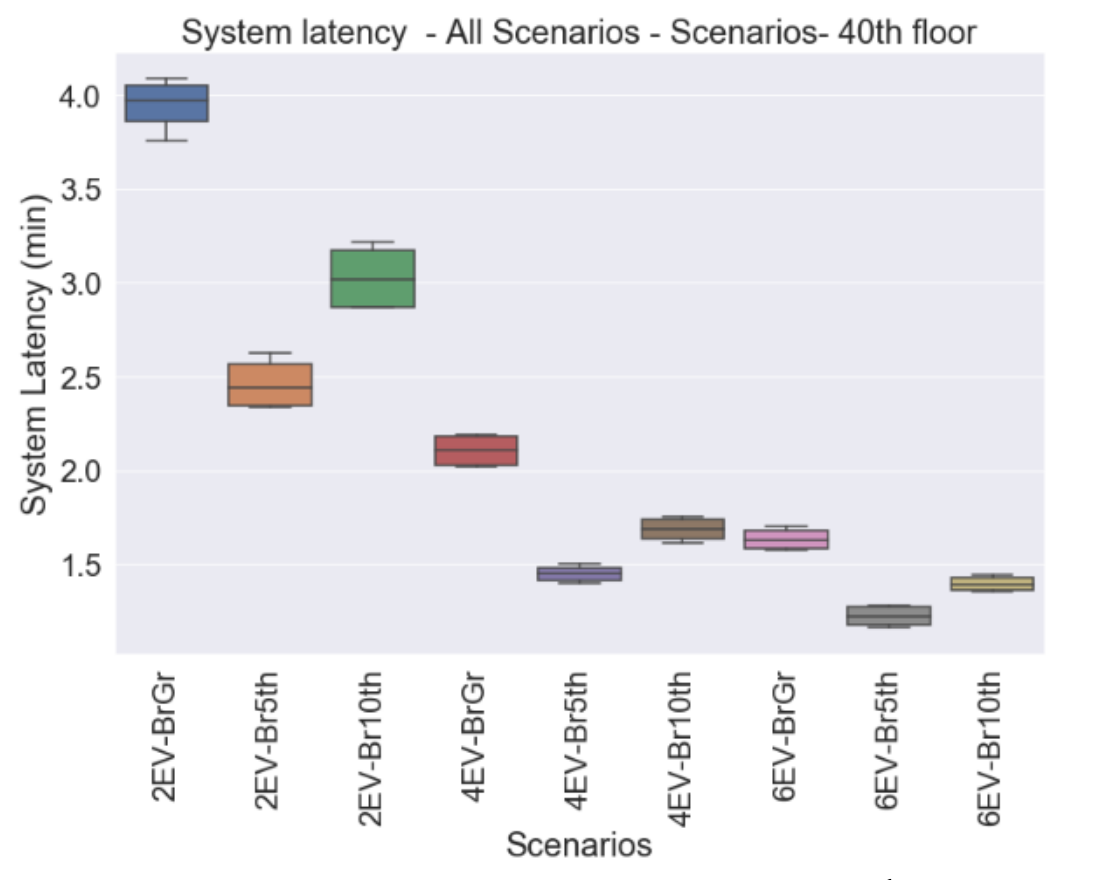
Figure 1 presents a graphical comparison of results across different scenarios. The Y-axis depicts system latency, suggested in this study as an indicator of system performance. System latency represents the average time required by the transportation system – elevators and staircases – to fulfill workers' intentions, like the time taken to reach a break room from the point of intention declaration.
To conclude, the agent-based simulation model is tailored to explore how vertical logistics influence available work time in high-rise construction. The simulation insights shed light on the critical role played by factors like elevator count and break room locations in shaping workers' waiting times. The model discussed in this paper has undergone further development and been practically employed in two construction projects. It has also incorporated real-time elevator data. The model generated worker location timelines were compared with manually collected data at five-minute intervals, producing a traffic pattern closely aligned with reality. The outcomes of this study can serve as a foundation for future articles.
References:
1. Al Barazi , A , Seppänen , O , Pikas , E , Lehtovaara , J & Peltokorpi , A 2021 , ENHANCING INTERNAL VERTICAL LOGISTICS FLOWS IN HIGH-RISE CONSTRUCTION: AN EXPLORATORY STUDY . in 29th Annual Conference of the International Group for Lean Construction . Annual Conference of the International Group for Lean Construction , International Group for Lean Construction (IGLC) , Lima, Peru , pp. 717-726 , Annual Conference of the International Group for Lean Construction , Lima , Peru , 14/07/2021 . https://doi.org/10.24928/2021/0143